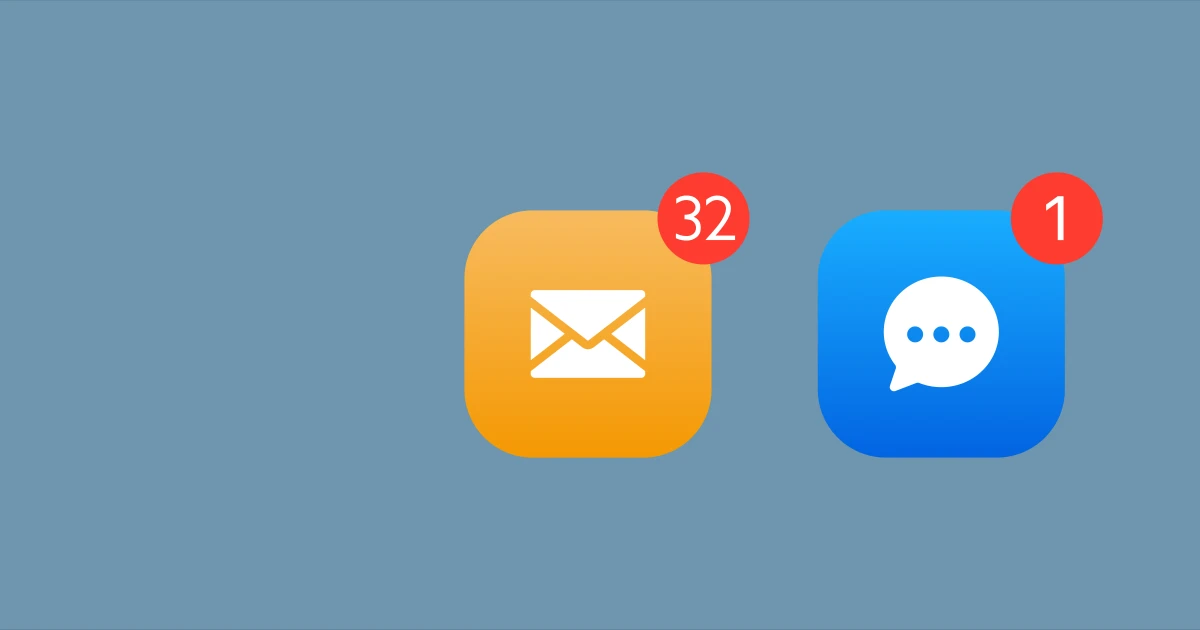
The debate between SMS and email marketing often comes down to one question: will my message actually be seen? The answer, backed by data from multiple industry studies, is overwhelmingly in favour of SMS. With open rates of 98% compared to email's 20-25%, text messaging delivers the visibility that businesses need for time-sensitive communications.
The Open Rate Comparison
Let's look at the headline numbers side by side:
- SMS open rate: 98% (Gartner, 2023)
- Email open rate: 21.3% average across all industries (Mailchimp, 2023)
- SMS read within 90 seconds: 90%
- Email read within 90 seconds: Less than 5%
These aren't marginal differences — SMS delivers nearly 5x the visibility of email. For any message where timing matters, the gap is even more significant.
Why the Gap Is So Large
Several factors explain why SMS consistently outperforms email on open rates:
- No spam folder: SMS messages arrive directly in the messaging app. There's no algorithmic filtering, no promotions tab, and no junk folder
- Push notifications: Text messages trigger a notification on the lock screen. Most people check their phone within seconds
- No competition: The average person receives 121 emails per day but only 5-10 text messages. SMS cuts through the noise
- Universal access: SMS doesn't require an internet connection, a smartphone, or an email account. Every mobile phone can receive texts
Response Rates Tell an Even Bigger Story
Open rates only measure whether a message was seen. Response rates measure whether it drove action:
- SMS response rate: 45% average
- Email response rate: 6% average
- SMS click-through rate: 19% average
- Email click-through rate: 2.6% average
The combination of higher visibility and higher engagement makes SMS marketing significantly more effective for campaigns that require a direct response — booking confirmations, limited-time offers, feedback requests, and appointment reminders.
When to Use SMS vs Email
This isn't about replacing email with SMS — it's about using the right channel for the right message:
- Use SMS for: Time-sensitive alerts, appointment reminders, delivery notifications, flash sales, two-factor authentication, payment reminders
- Use email for: Long-form content, newsletters, detailed product information, documents and attachments
- Use both: Send an email with full details and follow up with an SMS linking to it — this combination consistently delivers the highest engagement
The ROI Comparison
Despite SMS costing more per message than email, the return on investment is significantly higher. Industry data shows:
- SMS marketing ROI: Up to £71 for every £1 spent (Textlocal/DMA industry benchmarks)
- Email marketing ROI: £35-£42 for every £1 spent
The higher open rates, faster engagement, and stronger response rates more than compensate for the higher per-message cost.
Getting Started with SMS
If you're currently relying on email alone, adding SMS to your communication mix could transform your engagement metrics. Faretext makes it easy to get started — whether through our SMS API for automated messaging, Oello for manual campaigns, or Email to SMS for the simplest possible setup. View our pricing to see how affordable it is.
Sources: Gartner — Mobile Marketing Analytics · Mailchimp — Email Marketing Benchmarks · Radicati Group — Email Statistics Report